Sea Trial Report: Synapse 4-Magnetometer Array
Originally published in Sea Trial Report: Synapse 4-Magnetometer Array, Revision 1.1 (May 2023).
Written by Marine Magnetics Corporation.
System Overview
Synapse is a new ultra-light, high-sensitivity marine magnetometer array system based on low-power rubidium optically-pumped scalar sensors. The array is scalable from 1 to 30 units, with automatic time synchronization handled by the networking hardware in each towfish.
The rubidium magnetometer sensor can sample at rates up to 20 Hz while maintaining low noise, excellent resolution and sensitivity, and having only one dead zone: equatorial. In contrast to traditional optically pumped magnetometers, which have both equatorial and polar dead zones.
Synapse towfish can be used as standalone magnetometers or combined into an array and feature flexible configurations that may include any combination of the following sensors: scalar magnetometer, pressure sensor, altimeter and tilt/IMU. Standard configurations include a 1000m pressure housing, a network status LED and a leak detector. Telemetry and power are supplied to all nodes via the same 2-conductor link from the vessel. The Synapse evaluation system used for this demonstration included:
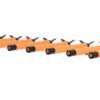
- A 4-magnetometer streamlined rigid and lightweight aluminum frame.
- The frame had an overall width of 3m and 1m magnetometer sensor spacing.
- An additional attitude node positioned in the center of the frame contained a pressure sensor, an altimeter (SBES) and a 3-axis gyrocompensated IMU for frame tilt monitoring.
- An 80m soft tow cable for towing the array, connected via a 6.3m Y-split adapter cable.
Summary
The Synapse Magnetometer Array System features small size, light weight, low power consumption, high sensitivity, and fast sampling for high data resolution.
This sea trial confirmed all of these features, and in addition highlighted fast and easy setup.
- Initial assembly of the four-sensor gradiometer and frame required minimal time (approximately 45 minutes) and allowed early transit to the survey area, maximizing data collection time.
- Finally, the array was easily deployable over the vessel side by two deckhands, meaning it was lightweight enough not to require a crane or other lifting device.
Inspection of the sensor profiles confirmed that the rubidium optically pumped magnetometer sensors exhibit low noise and show excellent time synchronization between all sensors in the array. Data processing required only the simple steps of diurnal correction and basic bulk shifting.
- No frequency-based filtering or advanced data manipulation was necessary to produce a coherent total field map.
- Two of the three notable anomalies on the magnetic maps matched the location of notable features on the MBES bathymetry data.
- The third magnetic anomaly had no corresponding surface expression in the bathymetry data and most likely originated from a buried source.
Despite the relatively small 3m width of the array frame, it’s clear from both data profiles and the interpolated maps that having four sensors was beneficial to capturing additional data over the encountered anomalies, helping enhance the resolution of the final data and adding valuable directional definition in each case, as compared to a single sensor towfish.
The main challenges encountered during the sea trial can be attributed to the control and behaviour of the prototype frame and its ability to handle the current. Ongoing work will involve design improvements to stabilize the frame, to reduce roll and pitch angles to reasonable levels, less than 10 degrees.
Overall, the sea trial successfully demonstrated the capabilities of the Synapse Array and the benefits of operating multiple simultaneous total-field magnetic sensors when detecting near-surface targets and hazards.